

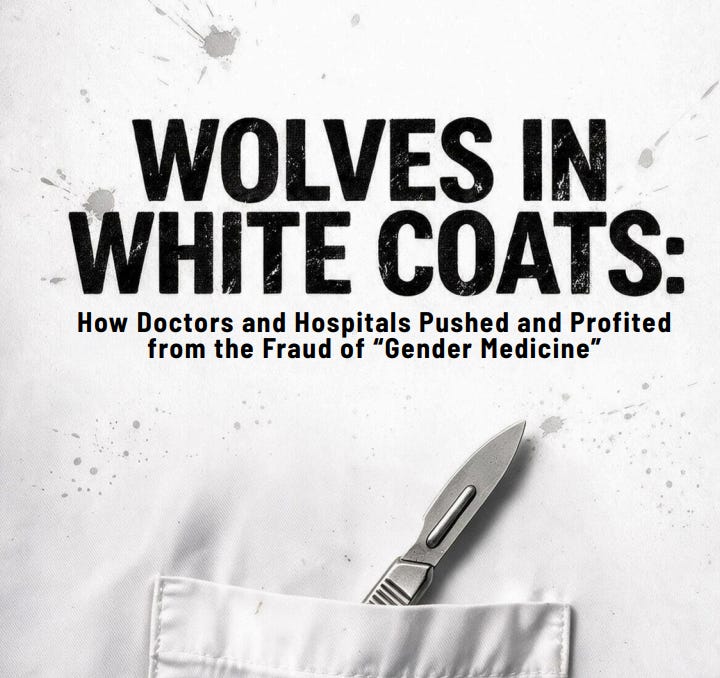
On Aug. 13, Vice President JD Vance, joined by U.S. Department of Health and Human Services (HHS) Secretary Robert Kennedy, Jr, and HHS Assistant Secretary for Health Admiral Brian Christine, announced the release of a commissioned report titled, Wolves in White Coats: How Doctors and Hospitals Pushed and Profited from the Fraud of “Gender Medicine.”
Vance, acting as chairman of the White House Task Force to Eliminate Fraud, announced the news alongside HHS on X. Vance’s post included a video statement on the report with remarks by all three men:

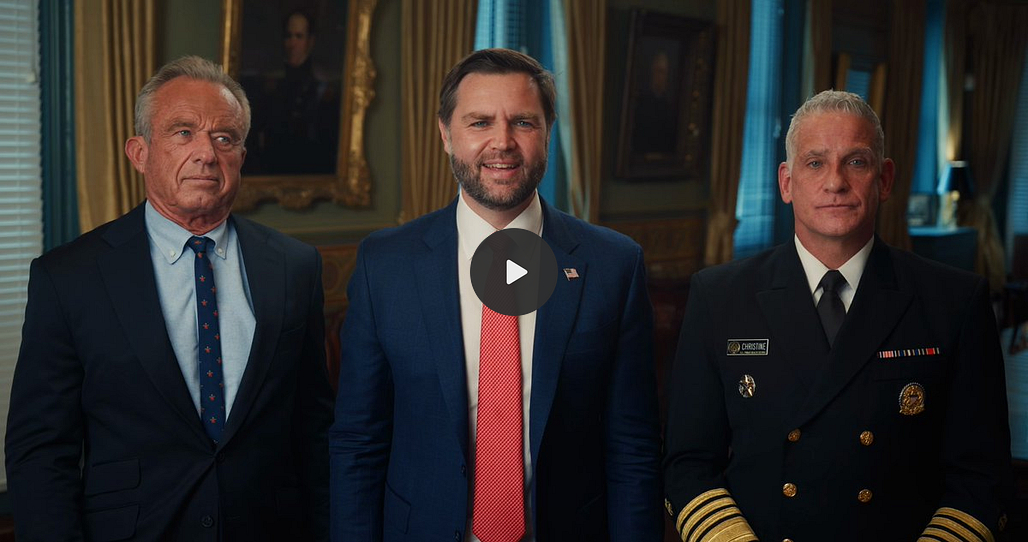
Former President Biden appointed “Rachel Levine,” a man living as a transgender woman, to the role Christine currently holds in March 2021. In the video clip posted by Vance, Christine calls out his Biden administration appointed predecessor by his given name, Richard Levine.
“My predecessor Richard Levine promoted gender affirming care for minors, and there’s nothing about that,” said Christine. “These are sex-rejecting, mutilating procedures for minors promoted by the Biden administration and thanks to President Trump’s leadership, we’re changing course.”
Christine goes on to describe WIWC exposing serious issues with evidence, informed consent, and “financial incentives.” He said 225 hospitals established pediatric gender offices nationwide that “preyed on vulnerable children.”
Christine says these hospitals told families their children needed “life-altering” procedures when all they really needed was “compassion and counseling.”
Levine arguably deserves those remarks, having pushed puberty blockers and “gender affirming care” while holding his post under Biden. Levine also worked with the World Professional Association for Transgender Health (WPATH), to eliminate age limit guidelines for transgender medical procedures.
The original WPATH draft guidelines suggested minimum ages for various treatments: Hormone Treatment (14), Mastectomies (15), Breast Augmentation (16), and Genital Surgeries (17).
However, internal emails revealed in a lawsuit showed that Levine and his team believed that publishing specific age recommendations could provoke ‘political backlash’ against the Biden administration and so-called transgender healthcare, and Levine pressured WPATH to hide them. Levine had claimed maintaining these age limits could ‘hinder access’ to healthcare for transgender youth.
WPATH’s work was exposed to be largely junk science in a 2024 report published by reporter Michael Shellenberger. Despite that report, WPATH continues to be cited to support the case for gender surgeries and hormones as well as in lawsuits filed against laws banning such practices for minors states like North Carolina.
In a follow-up post, Vance included a copy of a letter sent to U.S. Attorney General Todd Blanche, formally referring the report to the U.S. Department of Justice and HHS Inspector General for action.


Prisha Mosley, a detransitioner whose legal journey began in North Carolina, applauded HHS’ announcement of the report in a post on X.

Mosley, now 27, living in Michigan, underwent medical gender transition interventions as a minor, starting at the age of 16, while living in Gaston County, North Carolina. She describes a detransitioner as someone medicalized based on self-reported gender identity who later realized sex cannot be changed and instead suffered medical harm.
Identical to the description in the HHS documentary-style video, Mosley’s parents initially opposed the interventions but were put into crisis mode over to her suicidality. She says doctors pressured her parents with the question “Would you rather have a dead daughter or a living son?” and she said that they felt coerced into consenting.
The Wolves in White Coats Report
The report examines the rapid growth of pediatric gender programs, financial incentives, and insurance billing practices for sex-rejecting interventions like puberty blockers, cross-sex hormones, and surgeries, on minors.
A short documentary highlighting patient and parent accounts was released alongside the report:
Findings overview
More than 225 hospitals and health systems established such programs, per the report and announcement by Vance, Kennedy and Christine.
The report describes a “captive patient” model: otherwise healthy minors are placed on pathways of ongoing, often lifelong care, including recurring visits, monitoring, prescriptions, and possible surgeries. This pattern created recurring revenue streams for endocrinology, surgery, and related services that differ from typical short-term pediatric care.
The report’s figures and numbers
Average annual costs cited include roughly $545–$735 for hormones and about $16,385 for certain puberty blockers.
Surgical costs can range from about $12,000 for surgeries like a mastectomy, to over $100,000 for more complex procedures, with lifetime estimates reaching $25,000–$170,000 per patient depending on interventions.
A key focus of the report is diagnostic coding, or rather an arguable manipulation of diagnostic codes, to enable reimbursement and hide the true nature of the claims filed.
Analysis of nationwide claims found patterns in which puberty blockers were billed under codes for “endocrine disorder, unspecified” (E34.9) or precocious puberty (E30.1) rather than gender-related codes.
Precocious puberty is typically diagnosed and treated in much younger children (before age 8–9), with blockers usually stopped by around age 11; use of that code for patients ages 13–17 is flagged as inconsistent with standard practice and warranting review.
The report cites evidence that some advocates and providers discussed alternative coding approaches, sometimes for insurance coverage or confidentiality and the report recommends stronger oversight of coding/billing, program integrity reviews for public payers, and further investigation where warranted.
Nationwide claims data showed nearly $120 million in billed charges for related services on minors since 2019, including over 5,500 surgeries and 8,500 courses of hormones/blockers.
Key figures breakdown:
Approximately $50 million in insurance claims for puberty blockers billed under endocrine disorder codes (primarily E34.9) for patients ages 9–17, excluding typical precocious puberty indications.
Nearly $11 million in claims for puberty blockers billed under a precocious puberty code for patients ages 13–17.
Nearly $120 million in total billed charges for sex-rejecting procedures/services involving minors since 2019, including surgeries plus hormones/blockers.
These figures are presented in the report as signals warranting further review rather than definitive fraud totals. It is likely the referral to the Inspector General and Attorney General Blanche will result in activity by the recently announced Southeast Fraud Enforcement partnership.
In addition to the Wolves in White Coats referral, there is a related issue that recently came to light in North Carolina. The Center Square reported this past week that North Carolina’s Department of Health and Human Services was funding a transgender outfit promoting surgeries and hormone therapies banned by law in the state. The report says $1.28 million went to a nonprofit called “Charlotte Transgender Healthcare Group.”
North Carolina officials involved in the Southeast Partnership include State Auditor Dave Boliek, Attorney General Jeff Jackson, U.S. Attorney for the Eastern District of North Carolina Ellis Boyle, and U.S. Attorney for the Middle District of North Carolina Dan Bishop. A press conference on fraud activities that included announcing the partnership was held two weeks ago:
Access the Wolves in White Coats documents:
Full Report (64 pages)
More To The Story
North Carolina mentioned in report
North Carolina is mentioned 6 times in the 64-page report, but in limited context about a University of North Carolina-linked toolkit discussing diagnosis codes for hormones in certain care settings, and organizations. Included in the mention of the state were Western North Carolina Community Health Service and Novant Health Pediatric Endocrinology, appearing on referral lists of entities as having flagged claim patterns.

The report’s notes also cite North Carolina as one of several states having outlawed gender surgeries and hormone therapies for minors.
North Carolina Gender-Care Ban Lawsuit: From Challenge to Federal Withdrawal
A federal lawsuit challenging North Carolina’s 2023 ban on gender-transition treatments for minors has seen a significant shift in federal involvement.
In October 2023, the family of a then-9-year-old Durham boy identified in court papers as “Victor Voe,” along with a local physician and two LGBTQ advocacy groups, filed suit against state health officials and the North Carolina Medical Board.
The Voe case targeted Session Law 2023-111 (House Bill 808), which prohibits surgical gender-transition procedures, puberty blockers, and cross-sex hormones for minors and bars the use of state funds for those treatments. Under that law, violators face potential loss of medical licenses.
Plaintiffs argued the law violates the 14th Amendment’s Equal Protection Clause and the Affordable Care Act by discriminating on the basis of sex and transgender status, while also interfering with parents’ rights to seek what they describe as medically necessary care.
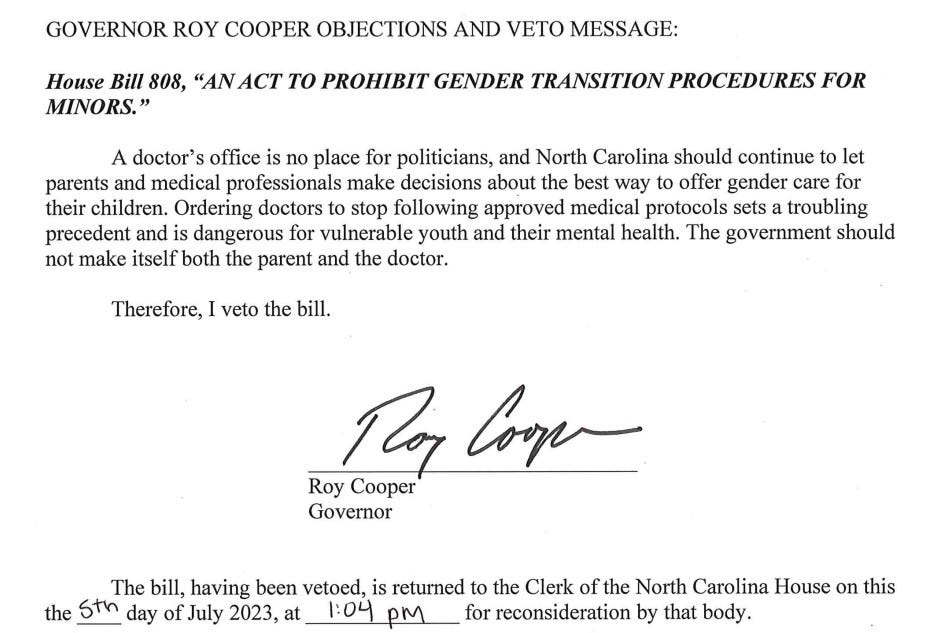
HB 808 had been vetoed by then-Gov. Roy Cooper, who is now running for the state’s U.S. Senate seat. Cooper’s veto message (seen below) claimed, “Ordering doctors to stop following approved medical protocols sets a troubling precedent and is dangerous for vulnerable youth and their mental health.”
Cooper’s veto was overridden by the Republican-led General Assembly. The override had no Democratic support in the Senate but two Democrats voted in favor in the House: Reps. Garland Pierce (Scotland) and Michael Wray (Northampton). Both Pierce and Wray were targeted by Cooper and the Democratic Party in the election that followed. Pierce survived but Wray lost his seat.
Supporters, including the N.C. Values Coalition, defended the measure as a safeguard against experimental treatments, pointing to restrictions adopted in several European countries and high rates of natural resolution of childhood gender distress.
Days after the lawsuit was filed, the Biden administration submitted a Statement of Interest supporting the plaintiffs, asserting the ban was subject to heightened constitutional scrutiny and likely to fail.
In late February 2025, the Trump administration formally withdraw that Statement of Interest in the Voe case. The filing, signed by acting U.S. Attorney Randall Galyon and Department of Justice Civil Rights Division officials, removed the federal government’s prior endorsement of the equal-protection claims made by the Biden administration.
The Voe lawsuit was dropped in June 2026 with all parties agreeing to dismissal with prejudice, which means the suit can’t be filed again in the future.