
What else doesn't the public know about Roy Cooper?
The Blue Ridge Times uncovered Cooper's family owned slaves

This election cycle, North Carolinians learned new things about former Gov. Roy Cooper, such as he had a first wife — who had no interest in being involved in politics and said Cooper had filed without even discussing it with her.
Watching Cooper’s campaign ad about “growing up on this farm,” North Carolinians probably also don’t know his family were slave owners either.
The following article is republished with permission from the Blue Ridge Times:
Darker Side Of Roy Cooper’s Nash County Roots, Including Slave Owning Ancestors
In his first TV ad to introduce himself to North Carolina voters, former Governor Roy Cooper, who is now running as the Democrat nominee for the U.S. Senate, portrays himself as a type of rural resident from Nash County. Obviously, Cooper declined to highlight that he is now in his fourth decade as a career politician. And he declined to share some of the more controversial details about his time in Nash County: the first marriage that he never mentions, his politically connected father, and slaveholding ancestors.
Abandoned his first marriage to run for office the first time
When Cooper first launched his campaign, the Blue Ridge Times reported on an exclusive Daily Mail story about former Governor Roy Cooper’s decision to leave his first marriage to run for the North Carolina State House. In the Daily Mail interview, Cooper’s first wife, Georgeanne Rice, says they began dating in college and got married in 1981. Here is her side of the story that led to the divorce. “I thought everything was great, until one day he came home and told me he had signed up to run for state representative. We had not discussed it or anything. We were in our mid-20s, and I wanted to start a family. I was completely flabbergasted that he would decide to run. He wouldn’t even discuss it with me; he just came home and told me.”
Rice continued, “I told Roy, I don’t want this life. We didn’t discuss this. It was a pretty major life decision.” Cooper went on to win that North Carolina House seat in 1985 and 1986, but they secretly split.
According to her, “I took a promotion and moved to Greenville. I still came back and went to campaign events for him, because he didn’t want anybody to know. But the day he won the election, I told him, if you lose, then we can talk about our marriage. But if you win, I didn’t sign up for this. He won, and he’s been in politics ever since.”
In a continuance of Cooper’s pattern of covering up his past, according to Rice, “When he first ran for governor, he called me and said, if somebody contacts you, please don’t say anything negative.”
Cooper’s Dad was a political boss, not a simple small-town lawyer
Roy Asbury Cooper III is running for Senate, and Roy Asbury Cooper Junior, was a prominent Nash County lawyer deeply involved in North Carolina politics. Roy Cooper’s father was key advisor to Democrat Governor Jim Hunt. In a 1980 article, Cooper Jr. said, “I have known Jim Hunt for 25 years and know that he is a dynamic leader.” This highlighted his enmeshment within North Carolina Democratic politics. In 2008, Cooper Jr. was inducted into the General Practice Hall of Fame, in recognition of his long career in the law and politics. Additionally, campaign finance records show that Cooper’s father donated thousands to Democrats across North Carolina, undercutting the small-town image that Cooper is campaigning on.
Long-time observers of North Carolina politics understand that Eastern North Carolina, places like Nash and Wilson County, were the key voting block for North Carolina Democrats to stay competitive in statewide elections, especially as the state trended more Republican.
Slave Holding Ancestors
Cooper campaigns on his rural roots, hoping that nobody notices that he moved to the city decades ago. He even proudly celebrated his ancestor Marcom Cooper who served as a juror during the Revolutionary War. But Cooper has declined to acknowledge his family’s slave holding history.
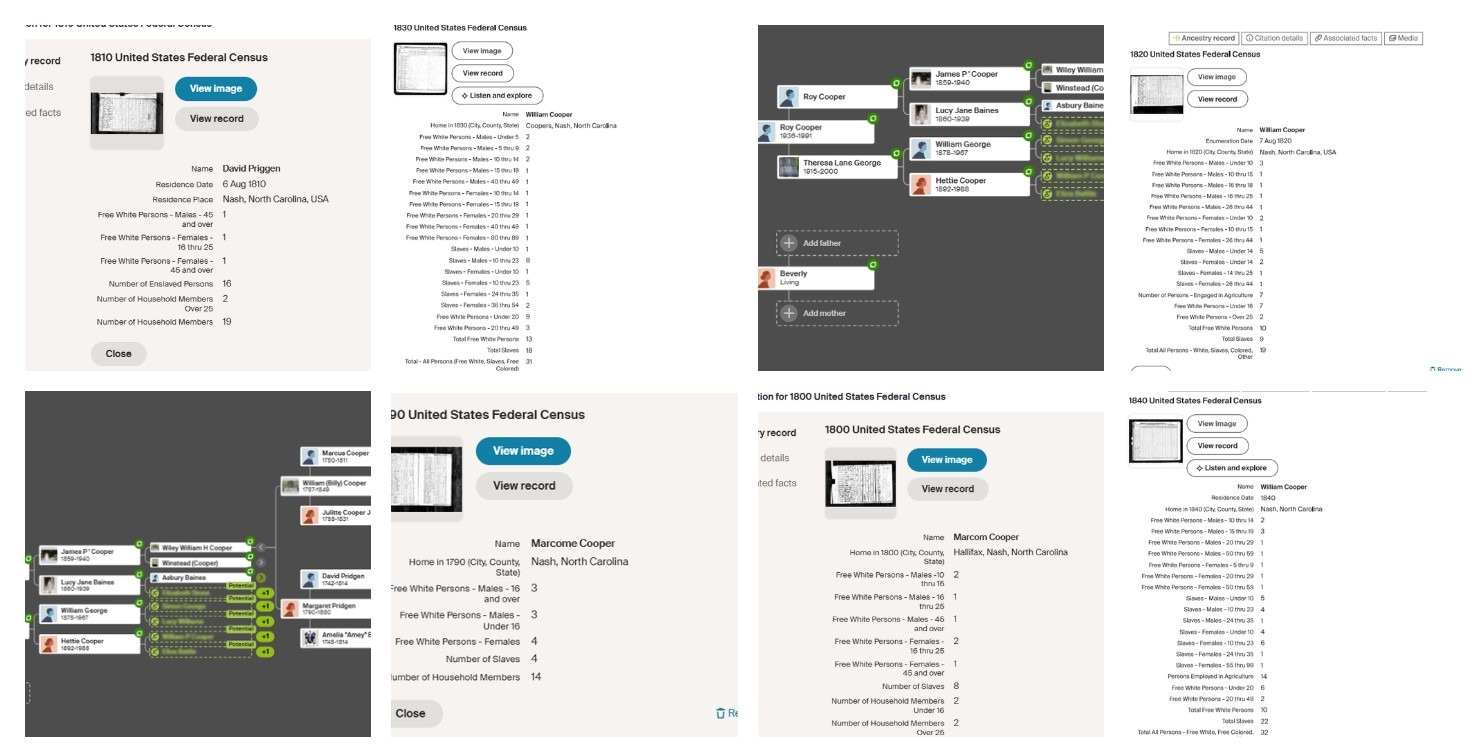
A search through census records in Nash County shows that after former Governor Roy Cooper’s relatives settled in Nash County, they quickly acquired over a dozen slaves, who were freed by the 13th Amendment.
The Cooper Family Tree built on Ancestry.com by Cooper’s daughter, Kristen, in 2018, lists several family members from antebellum Nash County.
Marcus Cooper (1750-1811) 4th great-grandfather.
1790 Census 4 slaves
1800 Census 8 slaves
1810 Census 8 slaves
Billy Cooper (1787- 1849) 3rd great-grandfather.
1810 census : 4 slaves
1820 Census: 9 slaves
1830 Census :18 slaves
1840 Census: 22 slaves
Willy Cooper (1822-1886) 2nd great-grandfather.
Reuters reports that Willie Cooper owned seven slaves.
David Prigen (1742-1810)
1810 Census: 22 slaves
Cooper has tried to paint himself as a simple country lawyer, but his financial disclosures show that Cooper is in-fact multimillionaire. Given his substantial real estate holdings, it seems fair to assume that Cooper himself has personally benefited from his family’s wealth passed down through the generations.
However, Cooper has declined to answer questions about reparations for slavery, even though he likely benefited from the institution economically through his family.
More To The Story
Before now, Cooper’s ancestry had not been reported on, even when such background became flashpoints during the 2020 George Floyd/BLM rioting and even after Cooper had monuments and statues linked to the Civil war removed from the Capitol grounds in June 2020.
Cooper issued a press release on the monuments being removed claiming it was in the best interest of “public safety,” and “Monuments to white supremacy don’t belong in places of allegiance, and it’s past time that these painful memorials be moved in a legal, safe way.”
Cooper left monuments of two major Confederate figures in place: Zebulon Vance and Charles Brantley Aycock. Both were Democrats and both owned slaves. Cooper’s office did not acknowledge my questions about why those two were exempted from being removed.
My records request on the cost of the removals and where the monuments were taken was stonewalled by the NC Department of Transportation — for nearly four years. The NCDOT told me they don’t know where the statues and monuments currently reside despite paying over $550,000 in taxpayer dollars to remove and transport them.
In 2019, over a year before the riots and monument removals, Virginia Gov. Ralph Northam was pilloried for his past yearbook page, which had a photo showing a student in blackface and another in KKK robes.
Then-Gov. Roy Cooper and other Democrats called out Northam and the photos. Despite growing calls to resign, Northam refused. Two other scandals hit Virginia Democrat around the same time: Then-Lt. Gov. Justin Fairfax was accused of sexual assault and Attorney General Mark Herring admitted he donned blackface at a college party.
Not long after the Northam yearbook debacle, the Daily Mail ran a story about similar photos found in a UNC Chapel Hill yearbook, noting the yearbook was from the same period when Cooper attended the school.
A News & Observer reporter broke the news of the UNC images. The reporter said he was “randomly flipping through old year books,” which at least one X user found to be weird. Also weird, the original post (below) by the reporter seems to have been deleted, yet a post replying to the deleted post which shows the full yearbook page still exists on X.

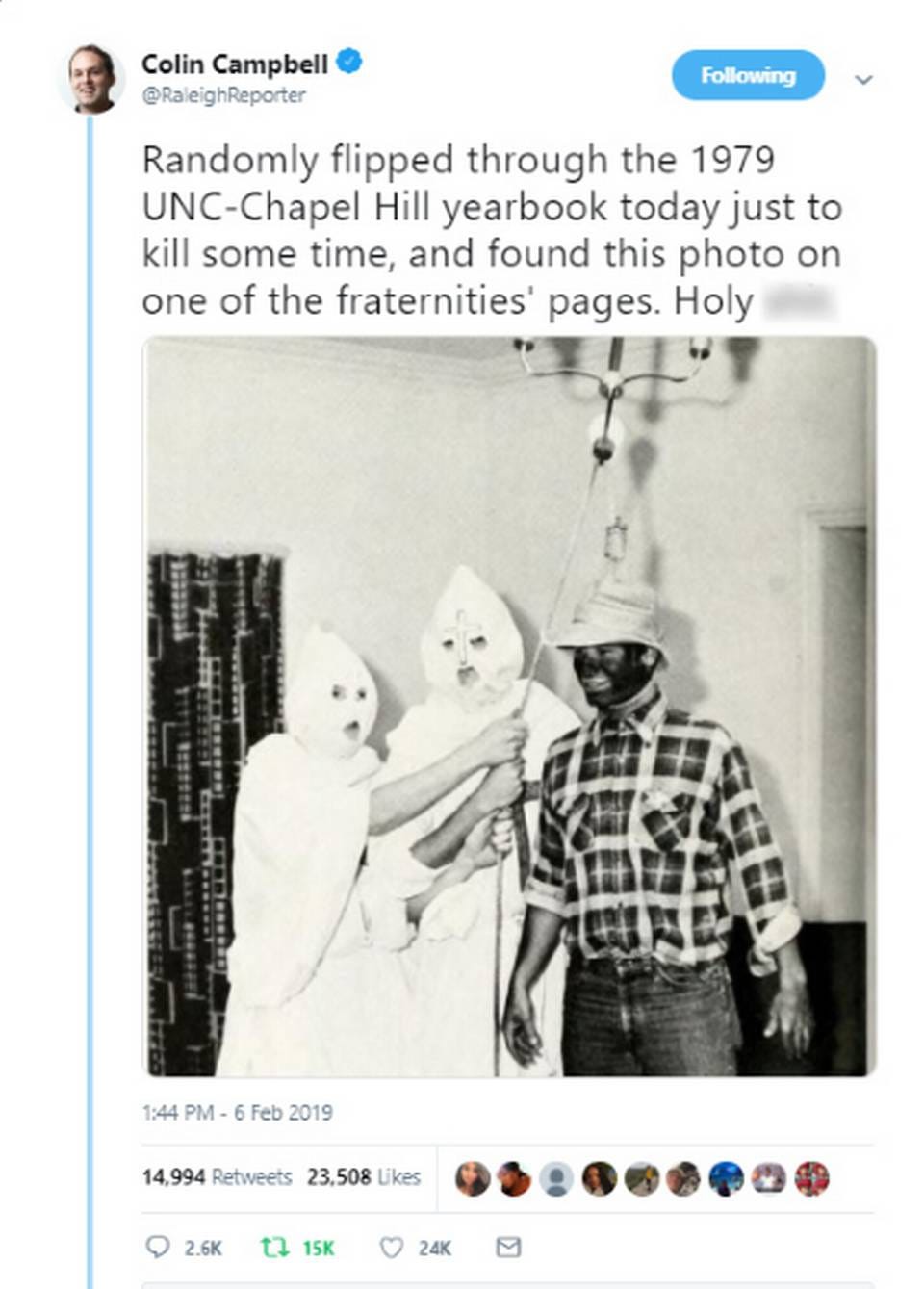
The News & Observer ran a story four days later debunking any involvement by Cooper.
Given what the Blue Ridge Times uncovered, the question now is will there be any mention or debunking of his family’s past slave ownership or will it be ignored and broomed under the carpet?