
SPLC's indictment just one aspect of group's activities
SPLC also runs an education arm, called "Learning for Justice"

Last week, an 11 count indictment was handed down by an Alabama grand jury against the Southern Poverty Law Center (SPLC). But that indictment outlines just one aspect of the group’s activities.
The SPLC also operates an education arm, called “Learning for Justice,” which has resources and materials used for “free” by teachers across the country.
Overview and History
Teaching Tolerance was launched decades ago as an educational offshoot of the SPLC. In February 2021, the program was officially rebranded as Learning for Justice (LFJ), and is still operating today.
Social Justice Standards; Mission and Goals
LFJ distributes “free” classroom resources, professional-development training, and curricular materials to teachers nationwide, with the explicit aim of turning schoolchildren into social-justice activists beginning in kindergarten using its “Social Justice Standards.”
LFG rolled out a core framework of Social Justice Standards built on Critical Race Theory follower Louise Derman-Sparks’ four goals for anti-bias education in early childhood. Its stated purpose is to instill identity politics, anti-racism, anti-sexism, LGBT awareness, and broader “social justice” activism.
Materials extend beyond public schools into churches, such as the Unitarian Universalist “faith development” programs, and these materials are promoted through district equity offices, social media, and teacher training.
(The Unitarian Universalist Church has funding links to Bishop William Barber and his Moral Monday/Poor People’s Campaign)Over the last decade, I had compiled and chronicled Learning for Justice’s activities. This article will lay out a summary of what I found. Please note, some of the links in that compilation are defunct, but I’ve tried to update them where possible.
Read about those standards in my past multi-part series spanning 2015 to 2017:
Social Justice Standards Launched by SPLC’s Teaching Tolerance
Common Core Aligned: Southern Poverty Law Ctr’s ‘Teaching Tolerance’
Social Justice Standards Components and Examples
The Social Justice Standards include “hard history” lessons — including an abundance of ‘slavery-themed frameworks’ for grades K–2 and 3–5.
These materials overwhelming use “philosophical presentism”— blending some historical facts with progressive bias, oversimplified narratives, identity-focused language, and hostility toward traditional religion, especially Christianity and Judaism.
The lessons, whether intentional or not, are arguably designed to sow divisiveness by framing issues through lenses of racism, sexism, sexuality, gender, and anti-American sentiment.
Professional development sessions on these standards were rolled out in districts as early as spring 2019 and appear to still be active on the LFG website, as least as a set of the standards published in the site in 2022 .
Vehicle for progressive ideologies
The FRC issued a 43-page report on LFG when it was called Teaching Tolerance, which includes some of the examples listed above, but digs deeper into the program’s framing of traditional beliefs as being racist, bigoted and intolerant while at the same time promoting LGBT affirmation, identity politics, and progressive activism.
In a nutshell, the report characterizes LFG as a vehicle for progressive ideologies rather than a neutral education on historical and social issue topics. And that programming has continued with a concentration of materials on its “resisting hate in education” page.
Other examples I’ve noted in the past include labeling concerned parents, like those opposing Common Core, as “extremists.”
The equating of SPLC’s “Hate Map” to real-world violence and extremism by media is another, while typically ignoring the Hate Map inspired the 2012 Family Research Council (FRC) shooting by Floyd Lee Corkins and a 2017 church arson in North Carolina.
Pervading themes of LFJ materials are the promotion of “cancel culture,” inaccurate or slanted content on topics ranging from 9/11, to illegal immigration, and socialist-influenced ideology — traceable to figures like Derman-Sparks, who had ties to Bill Ayers and Communist Party activist Dorothy Ray Healey.
In both pre and post-pandemic years, LFG has put out materials, articles and videos have included revisionist materials drawn from the main SPLC website.
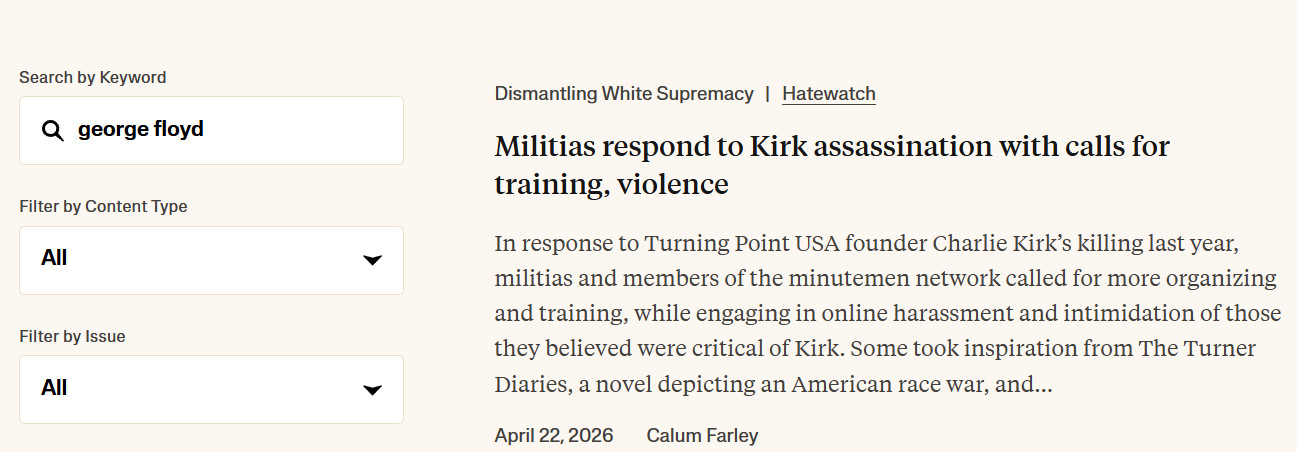
For example, post-George Floyd, many of the articles were propagandistic in nature, riddled with bias, missing hard facts like Floyd’s overdose, and the latest post when searching for Floyd links militia activity to the assassination of Charlie Kirk.
But don’t take my word for it, go look around.
LFG Reach & North Carolina
Resources are offered at no cost to educators, enabling wide adoption. Lesson plans can be downloaded on various topics and parents have sent me examples that have shown up in their child’s classroom — some as young as kindergarten.
Not unrelatedly, Wake County Public Schools’ Office of Equity Affairs, spent more than $8.69 million 2015 between 2015 and 2022 on related equity initiatives and that office’s first hire was a former Teaching Tolerance staffer – Lauryn Mascarenaz.
Mascarenaz left the district in Nov. 2021, which was not long after my series on Critical Race Theory teacher training her staff was conducting in every school in the district. She wasn’t the only one who left. Heading up the Office of Equity Affairs (OEA) at that time was Rodney Trice, who denied to the Wake School Board that any Critical Race Theory training or teaching was occurring.
Under Trice’s tenure, the OEA also rolled out a Black Lives Matter website and ran an event called “EdCamp Equity.” My reporting on EdCamp was the launch pad for Christopher Rufo’s first piece in his Critical Race Theory series.
Trice is now the superintendent at Chapel Hill Carrboro City Schools and he was recently called in to the legislature to explain why that district is skirting the Parents’ Bill of Rights law on multiple fronts: pronoun changes and books in elementary libraries with explicit sexual and gender ideolog content.
Rep. Grant Campbell (R-Cabarrus) confronted Trice on the books, and asked if he could agree that “materials that talk about sexuality, describing sexual acts, illustrating sexual acts, shouldn’t be in elementary school libraries.”
Trice refused, stating, “I’m not necessarily agreeing with that.”
Related News
The SPLC is a 501(c)3 organization. Given the organization’s recent indictment, this press release (below) is hardly coincidental and will have huge ramifications for activist groups using pass-throughs orgs to hide donor origins.
Treasury Announces Form 990 Transparency Initiative to Expose Hidden Funding and Strengthen Oversight