

A lawsuit has been filed against the Charlotte-Mecklenburg School (CMS) district over a chain of events that unfolded over a Charlie Kirk memorial message painted on the Ardrey Kell High School Spirit Rock.

Lawyers with Alliance Defending Freedom Legal (ADF) filed the complaint on behalf of a student identified in the filing as G.S., along with her parents.
“No student should be censored, punished, and shamed by school officials simply for sharing her views,” said ADF Senior Counsel Travis Barham. “Charlie Kirk boldly defended open and respectful discourse on school grounds literally until his last breath, and this courage inspired many across the country, including the student who painted the message on Ardrey Kell High School’s spirit rock.”
This situation goes beyond irony, however, as school officials illegally censored and threatened students for sharing a widely held message with which they happened to disagree.,” Barham said. “We are urging the court to hold the officials responsible for violating students’ constitutional rights to free speech, free exercise of religion, and due process.”
Although G.S. was given permission to paint the Spirit Rock, the district censored the message within hours, ordering it painted over.
“Within hours after G.S. and her friends finished painting the Ardrey Kell High School spirit rock, Defendant’s officials ordered her tribute to Charlie Kirk censored and painted over it,” the complaint states.
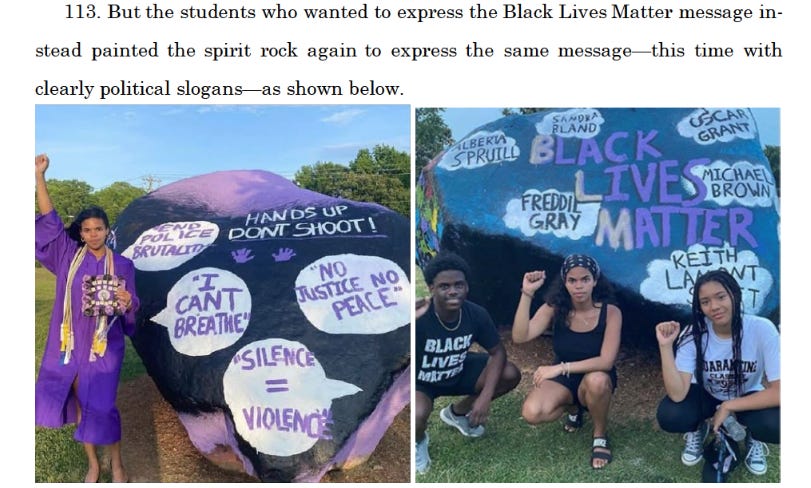
The complaint against CMS notes other groups were allowed to post political messages such as for Black Lives Matter and students were allowed to pose in front of the Spirit Rock.
The lawsuit alleges the school’s officials were influenced by CMS board members’ negative views of Kirk, with an example of Board Member Melissa Easley’s social media post (seen below) about Kirk’s death in which she refuses to feel sorry for his murder and in which she misspelled the word pity.
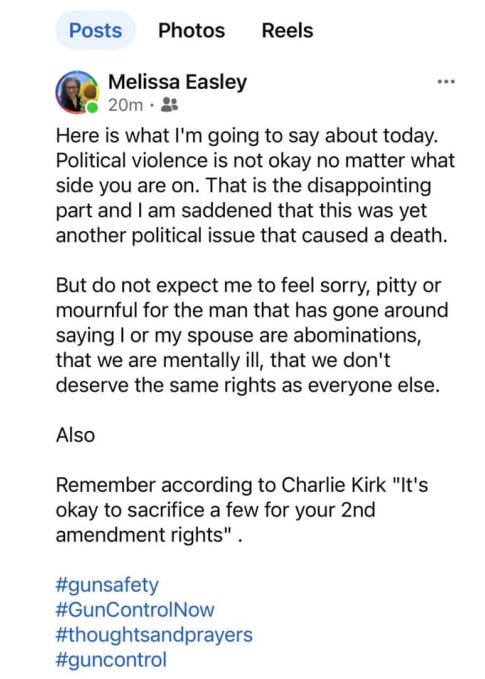
As Easley alluded in the post, her husband is transgender.
“She [Easley] and other people of like mind made it quite clear that they did not respect him or mourn his assassination,” the complaint states.
CMS was forced to issue a statement following Easley’s post:
“The views expressed by individual Board members are their own and do not represent the Charlotte-Mecklenburg Board of Education. The Board does not condone violence or environments that may create disruption. Our priority is our students and families, and we will continue to work collaboratively to ensure our policies and decisions reflect our unwavering dedication to educational excellence, safety and well-being.”
After drawing criticism for her post and following CMS’ statement, Easley doubled down. In a post on her official board member Facebook page, she claimed her original post was her personal opinion and that she “was speaking freely as an individual citizen,” despite being an elected school board official.

In reaction to G.S.’s memorial to Kirk, the CMS went out of its way to change the Spirit Rock Speech Code, effectively banning the type of message G.S. had painted on the rock.
The Code was altered to ban “religious, [sic] and/or political statements/symbols.” A requirement was added that messages “reflect positive school spirit and uphold inclusive values,” and be in “good taste.”
Targeting and Retaliation
According to the complaint, after the rock was painted over CMS officials publicly accused G.S. of violating the student code of conduct, followed by accusations of criminal vandalism in which officials called law enforcement and a criminal investigation was conducted.
The following day, G.S. was pulled out of class — twice.
“Defendant’s officials called her out of class, forced her to write out a statement summarizing her rock-painting efforts, and forced her to edit that statement to include details they believed to be important,” the complaint states. “And they did this without first advising G.S. of her constitutional rights in any criminal proceeding, including the right to remain silent and the right to have legal counsel.”
Although the investigation determined no vandalism had occurred, CMS officials refused to publicly clear G.S.’s name.
“Within three days, Defendant and its officials knew that G.S. had not engaged in vandalism and quietly closed the criminal investigation against her,” according to the complaint. “But they steadfastly refused to clear her name publicly, despite publicly accusing her of a crime before any investigation occurred and despite repeated entreaties from her parents (including entreaties to Defendant itself). Instead, they issued false public statements, claiming they had never investigated her for anything.”
Violation of Constitutional Rights
The complaint summed up the case, listing the Constitutional violations:
“Defendant and its officials unconstitutionally censored G.S.’s speech that the First Amendment protects, retaliated against her for exercising her First Amendment rights, adopted new policies that violate her First Amendment rights, violated the unconstitutional conditions doctrine, ignored her Fourth and Fifth Amendment rights, and deprived her of due process and equal protection of the laws.”
The lawsuit includes eight separate Constitutional Rights violation claims:
Violation of First Amendment free speech through content and viewpoint discrimination by both censoring and punishing her message.
Fourteenth Amendment due process by using vague, overbroad policies to punish her.
First Amendment retaliation by adverse actions such as the investigations of her over their protected right to expression.
First Amendment free exercise of religion by targeting her faith-based tribute.
Fourth Amendment unreasonable searches and seizures by forcing her statement and phone search without warrants or consent.
Fifth Amendment self-incrimination by compelling her statement without Miranda warnings.
Fourth and Fifth Amendment violations of imposing unconstitutional conditions on G.S. by forcing her “to write a mandated statement and allow its officials to search her cell phone to remain a student in good standing.”
Fourteenth Amendment equal protection by unequally punishing her for their views compared to others.
Remedies sought include declaratory judgment invalidating the Unwritten Spirit Rock Speech Code, Vandalism Policy, and Revised Spirit Rock Speech Code.
Additionally, the complaint seeks preliminary and permanent injunctions barring enforcement of those policies and codes.
G.S. and her parents also demand an order to remove negative investigation information from G.S.’s school records and they want the board to issue a letter of apology.
Additionally, “nominal, compensatory, and punitive damages; and costs, expenses, and attorneys’ fees are also being sought.
Read the full complaint.
More To The Story
The principal of Ardrey Kell was fairly new at the time of Kirk’s death and the Spirit Rock controversy. Susan Nichols had been named the new principal of Ardrey Kell High School on June 18, 2025.
Nichols replaced Jamie Brooks, who was mysteriously suspended with pay on May 2 and within weeks chose to retire. Charlotte-Mecklenburg Schools would not provide the reason for the suspension, citing personnel files and related matters as confidential.
Brooks’ suspension and departure coincided with a defamation lawsuit and hate crime lawsuit filed against Ardrey Kell High School.
In recent years, Ardrey Kell High School has made headlines arguably for all the wrong reasons.
In 2021, the Washington Free Beacon (WFB) exposed a lesson by English teacher Lisa Patrizio that “downplayed the Holocaust and likened 19th-century Americans to Nazis.” That report also revealed Ardrey Kell High School was sending monthly “Social Justice Newsletters” to families.
“The inaugural letter reported that the school taught students about relations between minorities and the police and asked children to reflect on their experiences of privilege and oppression,” the WFB report reads.
“In February, Ardrey Kell students learned about black nationalism and black power movements—including the extremist, anti-Semitic Nation of Islam,” reported to the WFB. “Weiss, whose husband is a retired police officer, said the school gave a presentation on policing featuring an ex-cop who “railed” against other policemen.
After some digging following the WFB story, I uncovered a slew of social and racial documents being imposed on students during homeroom sessions at Ardrey Kell that included a “Biden-Harris FAQ,” Black Lives Matter materials, “LGTBQ+ Learning,” and a slanted, emotional look at DACA. Critical Race Theory concepts like white privilege and inherent bias were also present.
Washington Free Beacon, April 15, 2021, “High School English Teacher Downplays Holocaust.”